
Search has changed – and it’s not just about Google anymore.
Consumers are increasingly turning to AI tools like ChatGPT, Gemini, Perplexity and Google’s AI Overviews to ask questions, compare suppliers and make decisions. Instead of scrolling through pages of links, they’re receiving curated answers.
And those answers include only a handful of brands.
In the first episode of the Stratitude Hotseat podcast, Sylvia Zanetti, MD and Lead Strategist at Stratitude, sat down with Digital Director Monde Mtolo to unpack what this shift means for businesses – and why visibility today is no longer just about rankings.
From “Being Found” to “Being Chosen”

As Sylvia framed it during the discussion:
Visibility today is no longer about who ranks first. It’s about who AI trusts.

Traditional SEO has focused on helping brands get found. But AI search works differently. Instead of listing multiple options, AI tools interpret intent, scan the web and surface a small number of trusted sources – sometimes without a single click.

Monde explained the shift clearly:
We’ve moved from competing to be found to competing to be chosen. If AI can’t clearly understand your expertise and trust your credibility, it simply won’t include you.
That distinction is critical. Brands are no longer competing for page position – they’re competing for inclusion.

What AI Actually Rewards
Despite the hype, the fundamentals of digital marketing haven’t disappeared. But the bar has moved.


During the podcast, Sylvia and Monde highlighted three areas brands should focus on:
AI systems scan for structure and meaning. If your website is vague, cluttered or inconsistent, it becomes difficult for AI to categorise your expertise.
As Monde noted:
“Clarity beats cleverness. AI needs to immediately understand who you help and how you help them.”
Plain language, strong structure and clearly defined services are essential

AI doesn’t just analyse your website. It looks at the broader ecosystem – media coverage, partnerships, reviews and third-party mentions.
“AI is looking for validation beyond your own marketing,” Monde explained. “Case studies, testimonials and industry features all act as trust signals.”
What others say about your brand matters just as much as what you say about yourself.
Fragmented messaging weakens credibility.
Sylvia reinforced that AI rewards alignment:
“When your strategy, content, campaigns and PR all tell the same story, trust builds. AI doesn’t reward isolated activity – it rewards consistency.”
If your website positions you one way and your campaigns suggest something else, AI struggles to confidently recommend you.
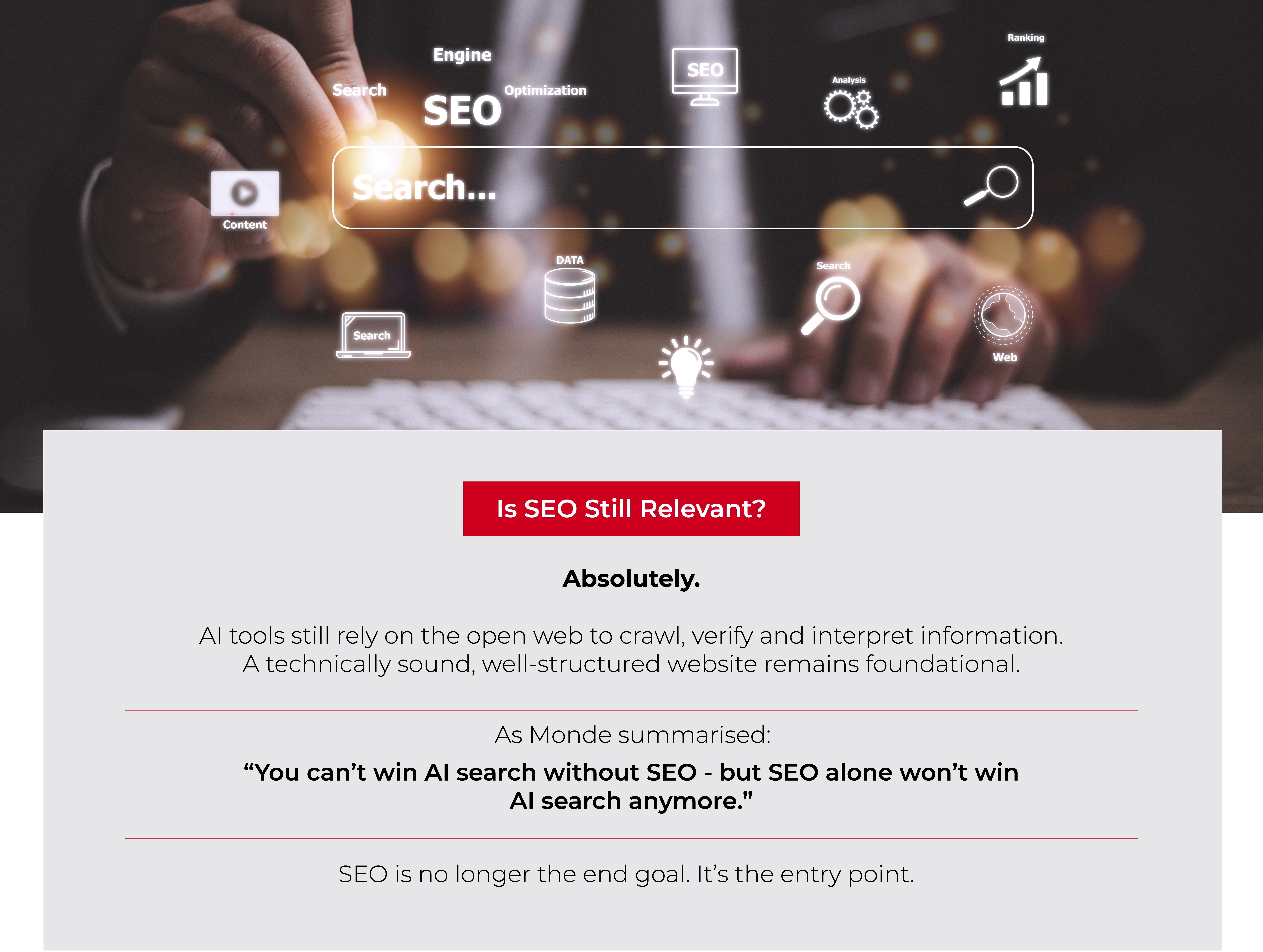
That distinction is critical. Brands are no longer competing for page position – they’re competing for inclusion.
The Strategic Takeaway
When Sylvia asked what one thing brands should prioritise this year to improve AI visibility, the answer wasn’t a new tool or tactic.
It was intentionality.
Choose a few core areas of expertise.
Answer real questions clearly.
Reinforce that positioning consistently across every channel.
The brands that win in AI-driven search won’t be the loudest.
They’ll be the clearest.
In a world where AI filters the noise, being understood has never mattered more.
To hear the full conversation between
Sylvia Zanetti and Monde Mtolo

Listen to the Episode 1 of
Stratitude Hotseat podcast:
Ranking in the Age of AI Search.